


Dental implants commonly require several months of healing before the definitive restoration is completed. While many patients hear about a standard 3 to 6-month window, there is actually no single healing period that applies to everyone. Some patients progress to their permanent teeth earlier, while others require a different timeline entirely.
Why? Because dental implant treatment does not end when the implant is placed. Surgery simply triggers a critical biological process, and understanding this waiting period is fundamental to modern implant dentistry.
The Science of Healing: What Is Osseointegration?
Osseointegration is the biological process where a biocompatible dental implant (typically made of titanium) establishes direct structural and functional integration with your surrounding jawbone.
When an implant is first placed, it achieves primary stability—a mechanical tightness within the bone. However, mechanical stability is not the same as biological integration. Over the following weeks and months, bone remodeling occurs around the implant surface. This means that a successfully placed implant is not automatically ready to support unrestricted chewing forces right away; it needs time for the bone to fuse tightly to it.
Why the 3–6 Month Rule Isn’t Absolute
The 3 to 6-month healing period is a general reference, not a fixed calendar rule. A straightforward single implant in healthy bone will follow a completely different timeline than a full-mouth rehabilitation.
Modern implant treatment is patient-specific. The goal isn’t to wait a predetermined number of months, but to proceed only when your body is biologically ready. Factors that influence this timeline include:
- Bone quality and quantity
- Primary implant stability
- Implant position (Upper vs. lower jaw)
- Number and distribution of implants
- Need for bone grafting or sinus augmentation
- Extent of the surgical procedure
- Patient-specific healing factors
- Planned prosthetic design and occlusal (bite) forces
The Impact of Bone Grafting and Sinus Lifts
Prolonged tooth loss often leads to reduced bone volume. In these cases, bone grafting or a sinus lift (creating vertical bone height beneath the maxillary sinus in the upper jaw) becomes necessary. Grafted areas require their own biological healing time. If a longer healing period is planned after grafting, it doesn’t indicate a problem—it is simply a necessary part of a safe, effective treatment protocol.
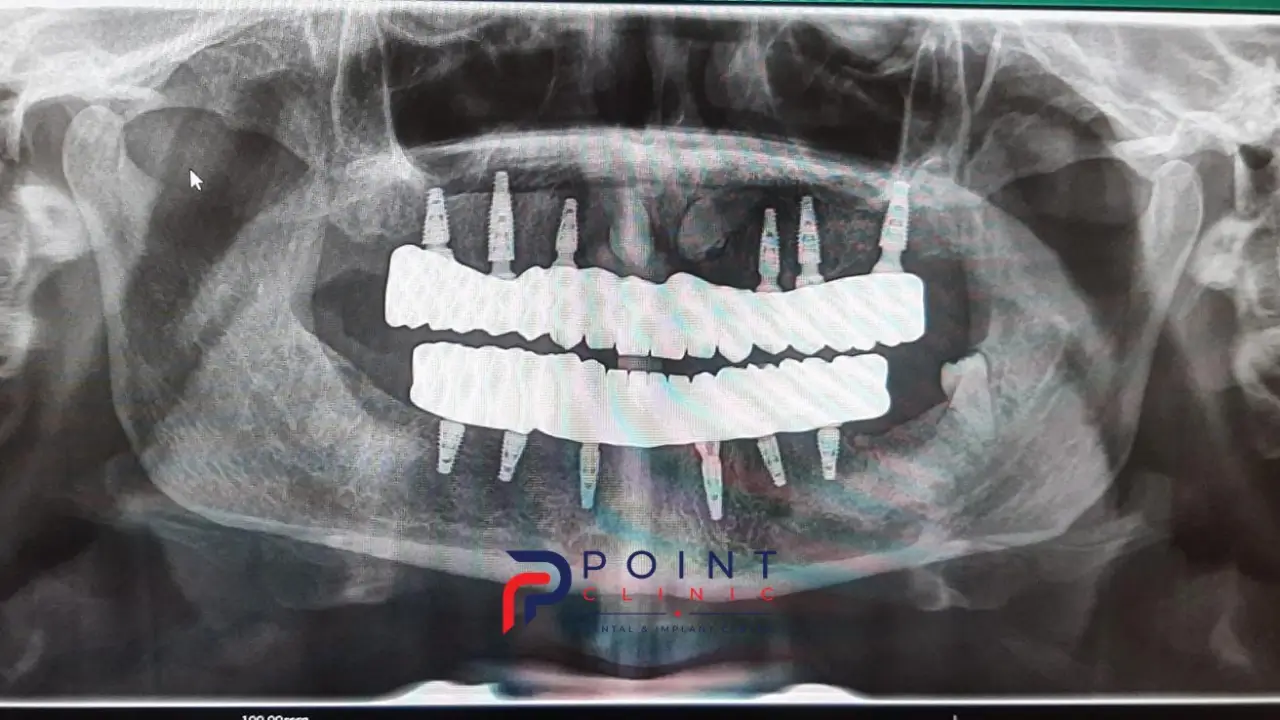
Real Case Study: 12 Neodent Implants at Point Dental Clinic
To see how these variables interact in reality, consider a full-mouth rehabilitation performed at Point Dental Clinic in Istanbul.
A patient from Romania, referred by a trusted friend who had previously been treated at the clinic, required comprehensive care. Following clinical and radiographic evaluation, the individualized treatment plan included:
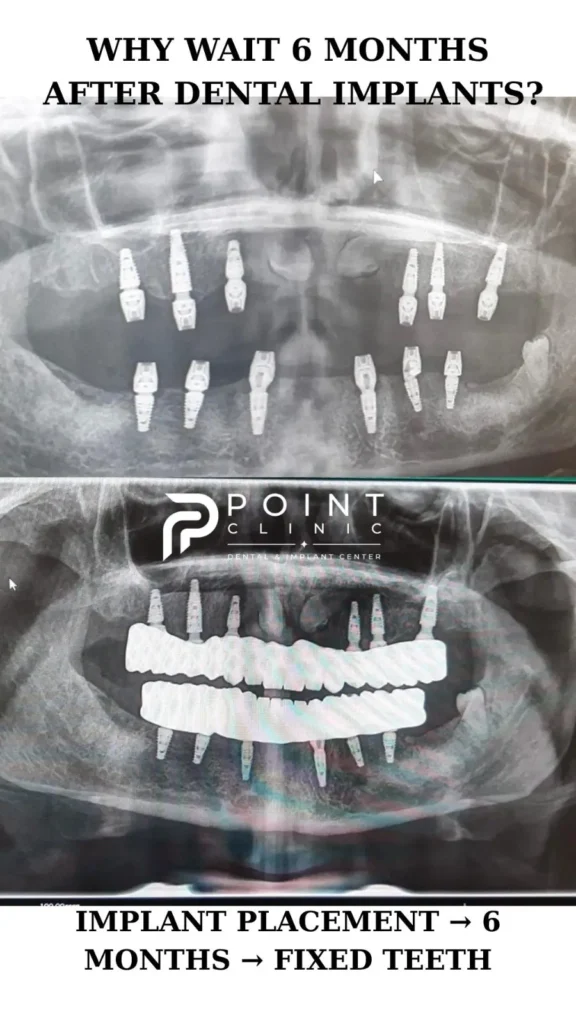
- 12 Neodent dental implants (6 upper, 6 lower)
- Sinus augmentation and bone grafting
- Temporary prosthetic rehabilitation
- Approximately 6 months of planned healing
- Definitive titanium bar-supported fixed zirconia restoration
Because complex sinus and bone augmentation were required, a 6-month healing phase was deliberately selected to protect the implants and surgically treated tissues.
What Happened During Those 6 Months?
While it might feel like “nothing” is happening between appointments, the healing phase is highly active biologically:
- Surgical tissues recover and soft tissues mature.
- Bone remodeling occurs, and osseointegration develops.
- Grafted areas solidify.
- The foundation for the definitive prosthetic stage is built.
The Role of Temporary Teeth
During this 6-month window, the Romanian patient was provided with temporary teeth. However, they were specifically instructed not to use them for normal chewing. In this complex case, the temporaries were purely for social and aesthetic purposes to protect the implants from premature functional loading.
Returning for Final Fixed Teeth: The Prosthetic Phase
After the healing period, clinical assessment and radiographic findings must be interpreted together to confirm the implants are ready. Time alone or a simple panoramic X-ray cannot tell the whole story.
Once osseointegration was confirmed for the Romanian patient, they returned to Istanbul for the final stage: a titanium bar-supported fixed zirconia restoration.
Why a Titanium Bar? The implants are only one part of the solution; the framework supporting the visible teeth is just as vital. Using modern digital CAD/CAM workflows, a custom titanium bar was designed to manage force, ensure a perfect prosthetic fit, and allow for proper hygiene. The quality of a full-mouth rehabilitation relies heavily on this unseen structural foundation.
Is Faster Treatment Always Better?
For international patients organizing flights, accommodation, and time off work, treatment speed is highly appealing. However, biological healing should never be compromised for convenience.
While modern dentistry offers “immediate loading” (placing permanent teeth immediately) for appropriately selected patients, it is not for everyone. Patient A (healthy native bone, single implant) and Patient B (full-mouth restoration with grafts) cannot follow the same timeline. At Point Dental Clinic, the clinical requirements determine the timeline—the timeline does not determine the treatment plan.
Frequently Asked Questions
How long do dental implants take to heal? Healing usually takes several months, but there is no universal timeline. It depends on bone quality, surgical complexity, and whether grafting was required.
What is osseointegration? It is the biological process where the dental implant develops direct structural and functional integration with the surrounding jawbone.
Does bone grafting or a sinus lift increase healing time? Yes, it can. Grafted tissues require additional time for biological healing and remodeling before they can support a permanent restoration.
Can I eat normally with temporary teeth after surgery? Not always. Protocols vary based on the surgery. Some temporary teeth are designed for function, while others are strictly aesthetic to protect the healing implants. Always follow your specific postoperative instructions.
Can permanent zirconia teeth be fitted immediately? In specific, favorable cases, immediate loading is possible. In complex cases requiring grafts, a healing period is absolutely necessary first.
How do dentists know when implants are ready for permanent teeth? Readiness is determined through clinical evaluation—assessing implant stability, tissue health, and radiographic findings—not just by looking at a calendar.
Point Dental Clinic is a premier dental destination in Istanbul, Türkiye, providing world-class implant dentistry, full-mouth rehabilitation, and advanced prosthetics for patients traveling from across the globe.
We combine expert clinical and radiographic diagnostics with modern dental technology. From customized implant planning and precision surgery to advanced prosthetic restoration, our treatments are specifically designed around your individual clinical requirements.
Recognizing that every smile is different, we begin with a detailed clinical and radiographic examination to design a treatment plan and timeline perfectly suited to your needs.
