


For individuals grappling with severe tooth loss in the upper jaw, the journey toward a confident smile often feels like an uphill battle against biology. Traditional dental implants rely heavily on the presence of high-quality jawbone, but for many, years of edentulism or the long-term use of ill-fitting dentures lead to significant bone resorption. When the maxillary bone becomes too thin or “paper-thin,” standard procedures are often ruled out, leaving patients feeling as though they have run out of options. This is where modern implantology shifts its gaze upward, utilizing denser, more stable anatomical structures to provide a foundation for permanent teeth.
Trans-Nasal implants represent a sophisticated leap in restorative dentistry, specifically designed to bypass the limitations of a depleted jawbone. By utilizing the dense cortical bone of the nasal floor—a region that remains remarkably stable even when the alveolar ridge has vanished—surgeons can now offer “graft-less” solutions to patients who were previously told they were not candidates for implants. This approach not only shortens the timeline to a functional smile but also eliminates the need for invasive bone grafting surgeries, ushering in a new era of efficiency and predictability in oral rehabilitation.

What are Trans-Nasal Implants?
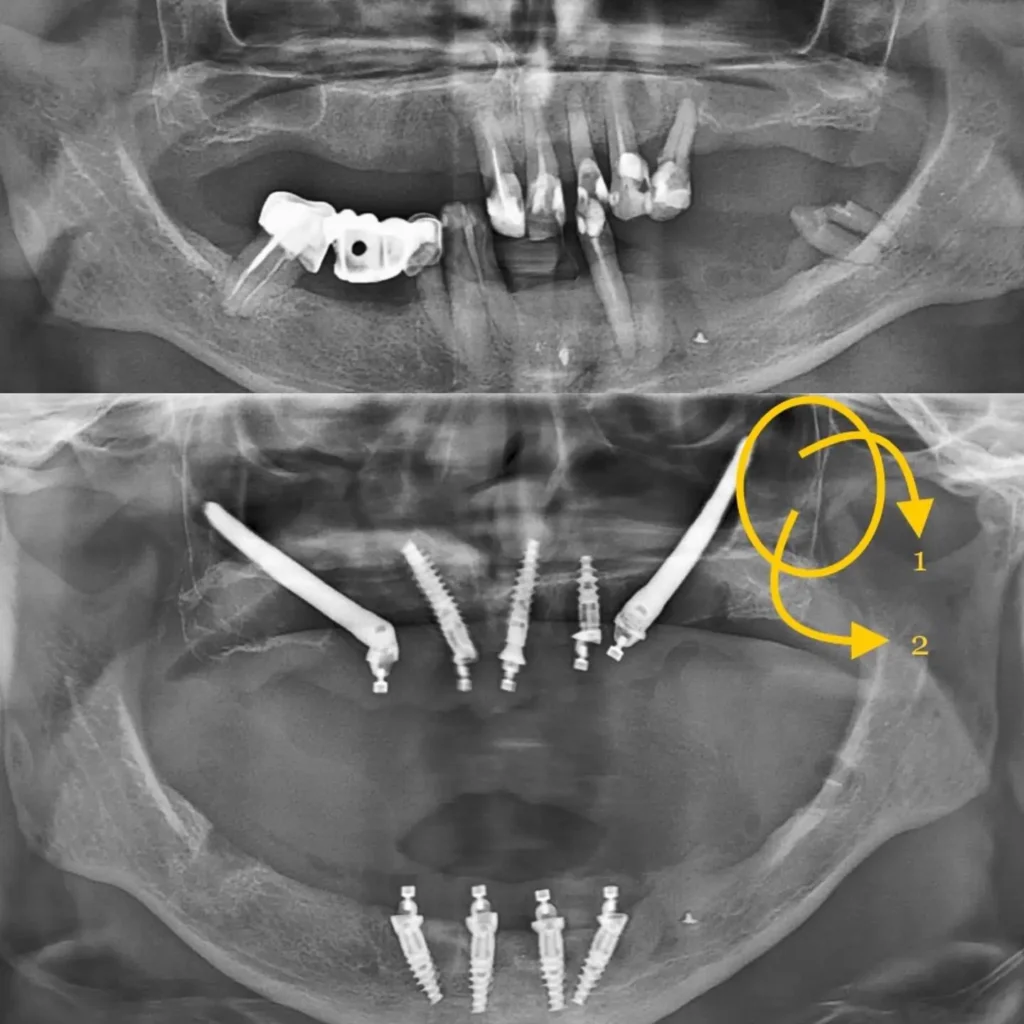
Trans-Nasal implants, often categorized alongside zygomatic and pterygoid implants, are specialized titanium fixtures designed to anchor into the cortical bone of the nasal floor or the piriform rim. Unlike standard implants that sit vertically within the alveolar ridge (the part of the jaw that holds tooth sockets), Trans-Nasal implants are typically longer and placed at specific angles to reach the stable bone structures near the nasal cavity.
The primary objective of a Trans-Nasal implant is to achieve primary stability in cases where the upper jaw (maxilla) lacks the height or width to support a traditional screw. By engaging the dense bone that forms the base of the nose, these implants provide a rock-solid foundation for prosthetic bridges, allowing for the “All-on-4” or “All-on-6” configurations even in the most challenging anatomical environments.
Trans-Nasal vs. Traditional Dental Implants
The distinction between Trans-Nasal and traditional implants lies primarily in anchorage and anatomy.
- Traditional Implants: These are usually 8mm to 13mm in length and require a healthy volume of alveolar bone. They are placed straight up into the jaw. If the bone is insufficient, the patient must undergo months of bone grafting or sinus lifts before the implant can even be placed.
- Trans-Nasal Implants: These are often longer and are strategically angled to “bypass” the hollow sinus cavities. Instead of waiting for a bone graft to heal, the surgeon utilizes the patient’s existing, high-density bone near the nasal floor.
While traditional implants are excellent for routine cases, Trans-Nasal solutions are the “heavy lifters” for complex rehabilitations, offering a faster route to permanent teeth by utilizing what the body already has available.
Ideal Candidates for Trans-Nasal Implant Procedures
Not every patient requires a Trans-Nasal approach, but for a specific demographic, it is a life-changing alternative. The ideal candidates include:
- Patients with Severe Atrophy: Individuals who have lost significant bone volume due to long-term tooth loss or trauma.
- Failed Previous Implants: Patients whose traditional implants failed because of poor bone quality or infection.
- Denture Wearers: Long-term denture users whose jawbone has “melted away” over time due to lack of stimulation.
- Aversion to Bone Grafting: Those who wish to avoid the pain, cost, and 6-9 month waiting period associated with major sinus lifts and bone augmentations.
- Need for “Teeth in a Day”: Patients looking for immediate loading protocols where a temporary bridge is attached shortly after surgery.
Addressing Severe Maxillary Bone Loss
Severe maxillary bone loss is a common consequence of aging and tooth loss. Once a tooth is removed, the jawbone no longer receives the biting pressure it needs to maintain its density. Consequently, the bone begins to resorb, and the maxillary sinuses (the air-filled cavities above your back teeth) begin to expand or “pneumatize.”
This creates a “sandwich” effect where there is very little bone left between the mouth and the sinus. Trans-Nasal implants address this by looking for bone in the “Zonal” anatomy. While Zone 1 (the front of the jaw) might have bone, Zones 2 and 3 (the back) often don’t. Trans-Nasal techniques allow the surgeon to anchor into the stable bone of the nasal aperture, effectively bridging the gap created by severe resorption.
The Role of the Nasal Cavity in Dental Implantology
It might sound intimidating to have an implant associated with the nasal cavity, but from a biomechanical perspective, it is one of the safest and most predictable sites in the mid-face. The nasal floor consists of high-density cortical bone, which is much stronger than the spongy (cancellous) bone typically found in the back of the maxilla.
In dental implantology, the nasal cavity serves as a landmark for “cortical engagement.” By resting the tip of the implant against or slightly into the dense bone of the nasal floor, the surgeon achieves “bicortical stabilization.” This means the implant is held firmly at two points, providing the mechanical strength necessary to support the force of chewing immediately after the procedure.
Key Advantages of Choosing Trans-Nasal Solutions
Choosing Trans-Nasal implants offers several transformative benefits for the patient:
- No Bone Grafting: This is the most significant advantage. By avoiding grafts, patients reduce their total surgery count, lower their risk of infection, and save thousands of dollars.
- Faster Results: Since there is no need to wait for a graft to “take,” patients can often receive a fixed temporary bridge within 24 to 48 hours.
- High Success Rates: Cortical bone is less prone to resorption than grafted bone, leading to excellent long-term outcomes.
- Reduced Discomfort: Fewer surgeries mean less overall trauma to the facial tissues and a faster return to daily life.
- Improved Esthetics: These implants allow for the placement of a bridge that restores not just teeth, but also the facial structure and lip support that is lost with bone atrophy.
The Trans-Nasal Surgical Procedure
The procedure is a masterpiece of digital precision and surgical skill. It typically follows these steps:
- 3D Imaging and Planning: The process begins with a CBCT scan (3D X-ray). The surgeon uses specialized software to map the exact density of the nasal floor and plan the angle of the implants to avoid nerves and vital structures.
- Sedation: Most Trans-Nasal procedures are performed under IV sedation or general anesthesia for patient comfort.
- Precision Drilling: Using the 3D map as a guide, the surgeon creates a narrow channel toward the piriform rim or nasal floor.
- Implant Placement: The Trans-Nasal implant is threaded into place, achieving high torque (tightness).
- Prosthetic Attachment: If the stability is sufficient, an impression or digital scan is taken immediately to create the new set of teeth.
Avoiding Sinus Grafts with Trans-Nasal Implants
For decades, the “Sinus Lift” was the gold standard for treating the thin upper jaw. This involved cutting a “window” into the side of the sinus, pushing the membrane up, and packing it with bone graft material. While effective, it is a highly invasive procedure with a long recovery time and a risk of sinus membrane perforation.
Trans-Nasal implants offer a “Graft-less” philosophy. By angling the implants anterior to (in front of) or medial to (beside) the sinus cavity, the surgeon can bypass the hollow space entirely. This “sinus bypass” technique ensures that the implant is anchored in the patient’s own living bone rather than a graft, which significantly reduces the risk of complications like sinusitis or graft rejection. It turns a complex, multi-stage process into a single, streamlined surgery.
When it comes to complex procedures like Trans-Nasal implantation, the experience of the surgical team is just as important as the technology used. At Point Clinic, located in the heart of Turkey, these sophisticated treatments are carried out by professional expert dentists who specialize in advanced oral rehabilitation. As a leading Istanbul dental clinic, Point Clinic is dedicated to providing “graft-less” solutions for patients with severe bone loss, combining clinical precision with a patient-centered approach. By choosing Point Clinic, you are not just getting a procedure; you are entrusting your smile to a team that stays at the forefront of global dental innovations to ensure your comfort and long-term success.
