


For many individuals facing significant tooth loss, the dream of a permanent, functional smile often hits a metaphorical wall: the lack of sufficient jawbone. Traditional dental implants rely on a sturdy “foundation” within the bone to anchor titanium screws. However, years of wearing dentures or the natural process of bone resorption can leave the jaw too thin or shallow to support these standard anchors. In the past, this meant undergoing months of painful bone grafting with no guarantee of success. But today, the resurgence of subperiosteal dental implants is offering a sophisticated, high-tech alternative for those who were previously told they were not candidates for dental implants.
Subperiosteal implants represent a marriage between architectural engineering and biological science. Unlike the “one-size-fits-all” approach of many medical devices, these are bespoke frameworks designed to sit atop the bone rather than inside it. With the integration of modern digital workflows, what was once a complex and unpredictable surgery has been transformed into a precise, minimally invasive solution. This guide explores how subperiosteal implants are redefining the possibilities for complex restorative dentistry, providing a lifeline for patients with severe bone atrophy.
What are Subperiosteal Dental Implants?
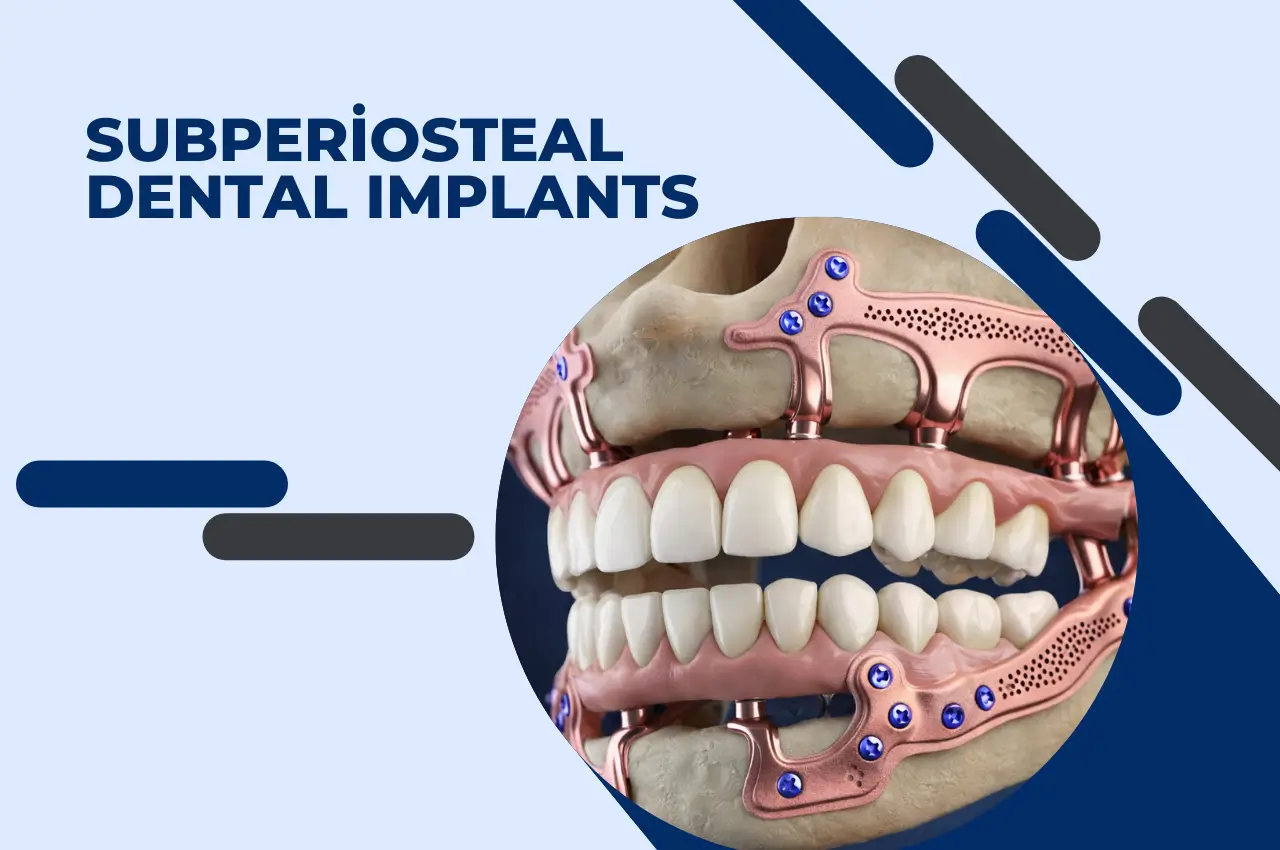
A subperiosteal dental implant is a custom-designed metal framework that is placed directly on top of the jawbone but underneath the gum tissue (the periosteum). The term “subperiosteal” literally translates to “under the periosteum.” The framework features several “posts” that protrude through the gums, which serve as the attachment points for the final prosthetic teeth or bridge.
Historically, these implants were crafted using impressions of the bone taken during a preliminary surgery. Today, however, they are manufactured using medical-grade titanium or cobalt-chrome through highly advanced 3D printing processes. Because the device covers a larger surface area of the bone, it distributes the pressure of chewing across the entire jaw structure rather than concentrating it in a single screw hole. This makes it an incredibly stable option for patients who lack the vertical bone height required for traditional methods.

How Subperiosteal Implants Differ from Traditional Implants
The primary difference lies in the interface with the bone. Traditional implants, known as endosteal implants, function like artificial tooth roots. A hole is drilled into the jawbone, and a screw is placed inside. For this to work, you need enough bone volume to surround the screw entirely.
In contrast, subperiosteal implants do not “invade” the bone depth. Think of an endosteal implant as a tent pole pushed into the ground, while a subperiosteal implant is like a saddle sitting on a horse’s back.
| Feature | Endosteal (Traditional) | Subperiosteal |
| Placement | Inside the bone | On top of the bone |
| Bone Requirement | Requires high bone density/volume | Works with minimal bone |
| Customization | Standard sizes | Fully custom-made for the patient |
| Grafting | Often requires bone grafts/sinus lifts | Usually avoids the need for grafting |

Who is the Ideal Candidate for Subperiosteal Implants?
While endosteal implants are the first choice for most, subperiosteal implants are the “gold standard” for a specific niche of patients. The ideal candidate is typically someone who has experienced extensive bone loss (resorption) in the upper or lower jaw. This often occurs in long-term denture wearers, as the lack of tooth roots causes the jawbone to shrink over time.
Additionally, candidates are often those who:
- Have been told they are “not a candidate” for traditional implants.
- Wish to avoid the long recovery times and multiple surgeries associated with extensive bone grafting.
- Are healthy enough for a surgical procedure but require a faster “teeth-in-a-day” or shortened treatment timeline.
- Have anatomical limitations, such as a low-hanging sinus or nerves that are too close to the surface for drilling.
When Are Subperiosteal Implants Recommended?
Dentists and oral surgeons typically recommend this route when the “cost-benefit” of bone grafting becomes unfavorable. For some patients, building enough bone to support a traditional implant would require multiple surgeries over 12 to 18 months. If a patient’s jaw is so thin that it resembles a “knife-edge” ridge, a subperiosteal framework provides a much more predictable outcome.
It is also highly recommended for elderly patients who may not want to undergo the physical strain of massive reconstructive grafting but still desire the quality of life that comes with fixed, non-removable teeth.
Addressing Severe Jawbone Atrophy and Bone Loss
Jawbone atrophy is a silent consequence of tooth loss. Without the stimulation of chewing, the body begins to reabsorb the minerals from the jaw, leading to a collapsed facial appearance and a lack of support for the lips. In severe cases, the bone becomes so thin that even basic dentures become painful or impossible to wear because they rub against sensitive nerves.
Subperiosteal implants address this by utilizing the basal bone—the dense, stable part of the jaw that does not resorb as easily as the alveolar bone (the part that holds teeth). By resting on this stable foundation, the implant provides a rigid structure that prevents further irritation to the gums and restores the facial profile without needing to “re-grow” the lost bone.
The Role of CAD/CAM Technology in Modern Design
The “renaissance” of subperiosteal implants is entirely due to CAD/CAM (Computer-Aided Design and Manufacturing). In the mid-20th century, these implants were prone to failure because they were hand-cast and didn’t always fit the bone perfectly.
Today, the fit is microscopic. Using specialized software, engineers design a framework that matches the contours of the patient’s jaw with 100% accuracy. This digital precision ensures that the framework doesn’t wiggle or create “dead zones” where bacteria can grow, significantly increasing the long-term success rate of the procedure.
3D Imaging and Digital Treatment Planning
The process starts with a high-resolution CBCT (Cone Beam Computed Tomography) scan. This provides a 3D map of the patient’s bone, nerves, and sinus cavities.
The surgeon can perform the entire procedure on a computer screen before ever touching the patient. Digital planning allows the surgeon to avoid vital structures like the mandibular nerve or the maxillary sinus. Because the plan is digital, the framework and even the temporary teeth can be manufactured before the surgery begins, often allowing for a “fixed” solution shortly after the operation.
The Surgical Procedure for Subperiosteal Implants
Thanks to modern technology, what used to be a two-stage surgery is now often a single-stage procedure.
- Incision: The surgeon makes a small incision in the gum tissue to expose the underlying bone.
- Placement: The custom-made titanium framework is seated onto the jawbone. Because it was designed from a 3D scan, it “clicks” into place with high precision.
- Fixation: Small, specialized screws may be used to temporarily hold the frame in place while the gum tissue heals over it.
- Suturing: The gums are closed, leaving only the small posts visible.
- Prosthesis Attachment: In many cases, a temporary bridge can be attached immediately, allowing the patient to leave the office with a functional smile.
Advantages of Choosing Subperiosteal Implants
The benefits of this approach are numerous, especially for those in complex clinical situations:
- No Bone Grafting: Avoids the morbidity and wait times of harvesting bone from other parts of the body.
- Faster Results: The time from the initial consultation to having fixed teeth is significantly shorter than traditional methods.
- Stability: Because the frame covers a wide area, it is incredibly stable and can support a full arch of teeth easily.
- Customization: Every aspect is tailored to the patient’s unique anatomy, ensuring maximum comfort.
Common Misconceptions About Subperiosteal Implants
“They are an outdated technology.” > While the concept is old, the execution is brand new. Comparing a 1960s subperiosteal implant to a modern 3D-printed titanium one is like comparing a typewriter to a high-end laptop.
“They are more prone to infection.”
With modern sterile techniques and CAD/CAM precision, the risk of “peri-implantitis” is no higher than with traditional implants, provided the patient maintains good oral hygiene.
“They are only for the elderly.”
While common in older patients, anyone with trauma-induced bone loss or congenital missing teeth can benefit from this technology.
Subperiosteal implants represent the pinnacle of personalized dental medicine. By bypassing the limitations of biology with the precision of digital engineering, they offer a second chance at a permanent smile for those who thought they were out of options.
High Success Rates and Expert Care at Point Clinic: Your Leading Istanbul Dental Clinic
At Point Clinic, we specialize in transforming lives through advanced restorative techniques that push the boundaries of modern dentistry. Our team of expert surgeons is highly experienced in the precision-driven world of subperiosteal implants, ensuring that even patients with extreme bone loss receive a custom-tailored solution. By utilizing the latest digital workflows and 3D metal sintering technology, our Istanbul dental clinic provides a level of surgical accuracy that minimizes recovery time while maximizing patient comfort and long-term stability.
Choosing Point Clinic for your subperiosteal procedure means trusting a facility where high success rates are the standard, not the exception. We understand that traveling for health tourism requires confidence; therefore, we combine world-class dental expertise with a patient-centered approach that guides you through every step of your journey—from the initial 3D scan to the final placement of your new smile. As a premier Istanbul dental clinic, we are proud to offer these life-changing implants to international patients, delivering durable, aesthetic results that restore both dental function and self-esteem.
