


For many patients suffering from severe bone loss in the upper jaw, the dream of a permanent, functional smile feels out of reach. Standard dental implants require adequate alveolar bone; in cases where years of tooth loss or periodontal disease lead to significant atrophy, the maxillary sinus expands, leaving little room for hardware. Sinus lift surgeries and bone grafting have long served as the conventional workarounds. These involve lengthy healing periods, multiple invasive procedures, and a high risk of complications. The evolution of cortical bone anchoring revolutionized restorative dentistry, offering a direct, efficient path to rehabilitation.
Pterygoid implants represent a sophisticated leap in implantology, specifically designed to bypass the need for bone grafts by utilizing the dense, stable bone located at the back of the upper jaw. By anchoring into the pterygoid process of the sphenoid bone, these implants provide a “foundation of last resort” that remains remarkably resilient. This approach shortens the overall treatment timeline; it allows patients previously told they were ineligible for implants to enjoy the stability of a fixed prosthesis. This specialized technique serves as a gold standard for complex maxillofacial restoration.
What Are Pterygoid Implants?
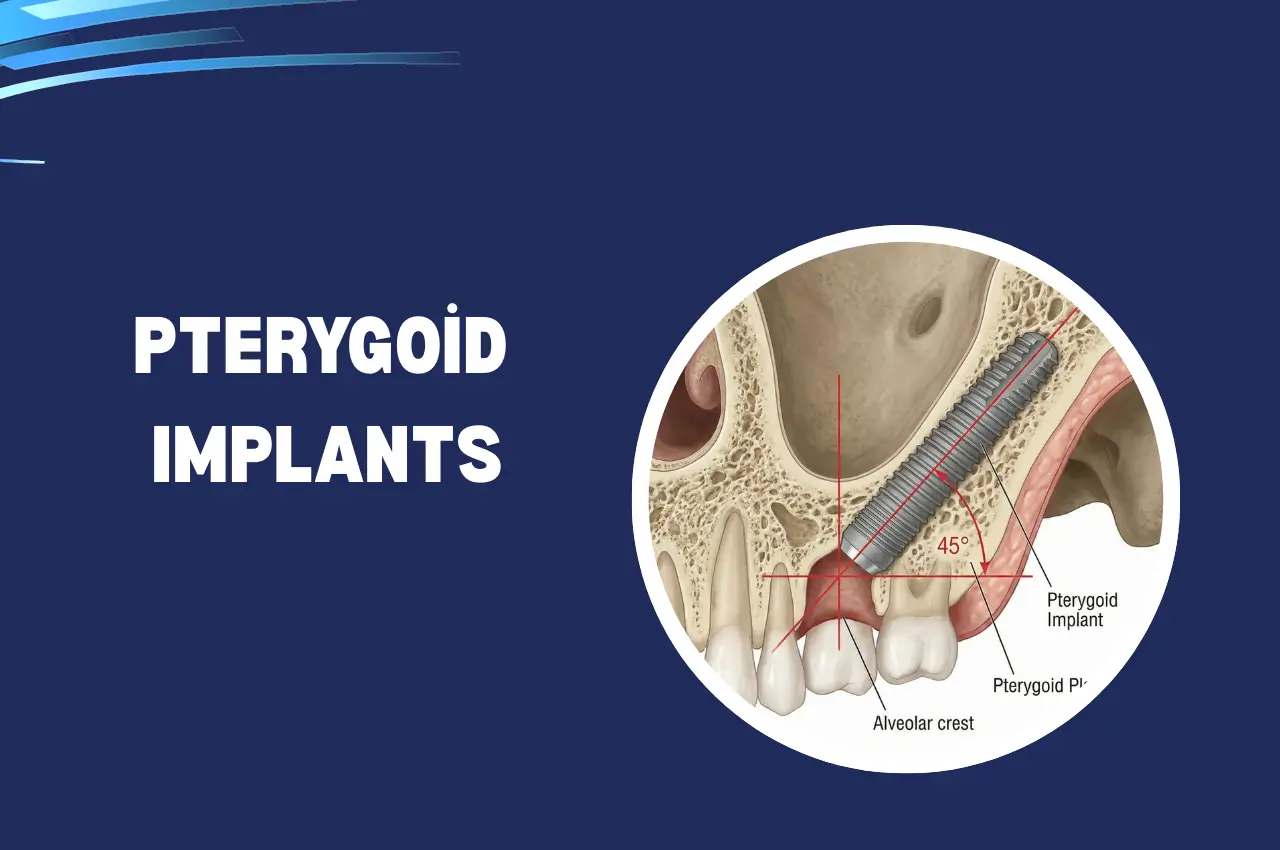
Pterygoid implants are a specialized type of dental implant designed to address total or partial edentulism in the posterior maxilla. These implants are placed at a specific angle, passing through the maxillary tuberosity to engage the pterygoid plate of the sphenoid bone.
This specific anatomical region consists of dense cortical bone. Unlike the alveolar bone that holds teeth, this bone does not resorb over time. The area remains biologically stable, providing excellent primary stability for dental prosthetics. Developed in the 1980s, these implants serve as a strategic pillar for a full-arch bridge. They allow dentists to avoid the maxillary sinus entirely, eliminating the need for complex sinus augmentation or invasive grafting.
This specific anatomical region consists of dense cortical bone. Unlike the alveolar bone that holds teeth, this bone does not resorb over time. The area remains biologically stable, providing excellent primary stability for dental prosthetics. Developed in the 1980s, these implants serve as a strategic pillar for a full-arch bridge. They allow dentists to avoid the maxillary sinus entirely, eliminating the need for complex sinus augmentation or invasive grafting.

Benefits of Pterygoid Implants
The primary advantage of choosing pterygoid dental implants is the total elimination of bone grafting. For the patient, this translates to fewer surgeries, less post-operative swelling, and a much faster transition to permanent teeth.
- Immediate Loading: The stability provided by the pterygoid bone allows for “teeth in a day” protocols. A temporary bridge is attached immediately after the surgery.
- High Stability: Anchoring into cortical bone makes the implant less prone to fluctuations in density found in other parts of the jaw.
- Simplified Treatment: Avoiding sinus lifts removes the risk of sinus infections or graft failure from the clinical equation.
- Enhanced Posterior Support: They provide crucial distal support for a dental bridge. This prevents the “cantilever” effect, which involves a bridge hanging off the last implant and potentially leading to mechanical failure.
Success Rates of Pterygoid Implants
Clinical studies over the last three decades show that pterygoid implants boast success rates equal to or exceeding traditional implants. Statistics show the success rate stays between 92% and 98%
The longevity of these implants relates to the quality of the bone in the pterygomaxillary region. The upper jaw consists of soft bone (Type IV bone); the pterygoid plate consists of dense bone (Type I or II). This ensures that once the implant is osseointegrated—meaning the bone has fused to the titanium—it remains incredibly stable under the immense pressure of chewing and daily function.
Are Pterygoid Implants Safe?
The idea of placing an implant deep into the back of the jaw might sound daunting. Pterygoid implant placement is a safe, well-documented procedure when performed by an experienced oral surgeon or periodontist.
Modern safety is guaranteed through several high-tech layers:
- 3D Cone Beam CT (CBCT) Scanning: Surgeons use high-resolution imaging to map out the exact path of the implant, avoiding vital structures like the palatine artery.
- Guided Surgery: Clinicians employ 3D-printed templates to ensure the implant is placed with sub-millimeter precision.
- Biocompatible Materials: These implants use medical-grade titanium or zirconia. The human body naturally accepts these materials, facilitating a healthy healing process.
Pterygoid Dental Implants Cost
Evaluating pterygoid implants cost requires looking at the “total value” of the procedure, especially in a leading dental hub like Turkey. A single pterygoid implant is more expensive than a traditional implant. This is due to the surgical expertise required and the specialized length of the implant body, which measures 15mm to 20mm.
Dental clinic in Istanbul, the average price for a single pterygoid implant ranges between €1,100 and €1,600. While this is higher than a standard €500 implant, the savings come from what you avoid. A traditional sinus lift in Turkey costs approximately €600 to €1,000 per side, and bone grafting can add another €400 to €800. By removing the need for these expensive secondary surgeries, the total cost for a full-arch restoration—including pterygoid support—becomes more affordable. Packages for a full upper jaw restoration involving pterygoids in Turkey range from €7,500 to €12,000, which includes the surgical fees, the prosthesis, and often luxury accommodation.
How Are Pterygoid Implants Placed?
The process of pterygoid implant placement is a blend of high-tech planning and surgical artistry.
- Consultation: The surgeon performs a CBCT scan to analyze the bone density and the exact location of the pterygoid plates.
- Angulation: During surgery, the implant is inserted at a 45-degree angle through the maxillary tuberosity. This allows the tip of the implant to anchor into the dense cortical bone of the sphenoid.
- Torque: The surgeon measures the insertion torque. If it meets the required threshold, the patient receives their new teeth on the same day.
- Integration: Over the next 3 to 6 months, the bone fuses with the titanium, creating a permanent, rock-solid bond.
Zygomatic and Pterygoid Implants Difference
Her iki seçenek de ciddi kemik kaybını ele almaktadır. Destek sağlamak için farklı “ekstramaksiller” kemikleri hedef alırlar.
| Feature | Zygomatic Implants | Pterygoid Implants |
| Anchorage Site | Zygoma (Cheekbone) | Pterygoid plate (Sphenoid bone) |
| Location | Mid-face / Canine region | Posterior / Back of the mouth |
| Length | Long (30mm – 55mm) | Medium-Long (15mm – 20mm) |
| Purpose | Supports the front of the arch | Supports the back of the arch |
In short, zygomatic implants replace the need for bone in the front and sides of the jaw. Pterygoid implants provide the necessary backstop for a full set of teeth.
Who Is a Candidate for Pterygoid Implants?
An individual is an ideal candidate for this procedure in several scenarios:
- The patient has been told they have “no bone” in their upper jaw.
- The patient wants to avoid the 6-12 month waiting period associated with bone grafting.
- The patient wears uncomfortable removable dentures and desires a fixed, permanent solution.
- The patient experienced failed previous sinus lift surgeries or traditional implants.
- The patient suffers from severe maxillary atrophy due to long-term tooth loss or age.
Recovery After Pterygoid Surgery
Recovery is remarkably similar to traditional implant surgery. Patients experience mild swelling and bruising at the back of the mouth for 3 to 5 days. In most cases, over-the-counter pain relievers are sufficient. A diet consisting of soft foods is recommended for the first few weeks. This allows the area to heal without excessive pressure from hard foods. Special antimicrobial mouthwashes are prescribed to keep the surgical site clean and free of bacteria. Most patients return to work within 48 hours and feel only mild discomfort.
Zygomatic and Pterygoid Implants: A Combined Solution for Upper Jaw Bone Loss
For patients with the most extreme cases of bone resorption, a combination of zygomatic and pterygoid implants offers a total “graftless” rehabilitation. By using two zygomatic implants in the front and two pterygoid implants in the back, surgeons create a four-pillar foundation. This foundation is strong enough to support a full bridge of 12 to 14 teeth.
This combined approach is the ultimate solution for the “atrophic maxilla.” It provides a life-changing transformation, restoring the ability to eat and speak. Over time, it also repairs the facial structure that has collapsed due to jawbone loss. This synergy allows even patients with zero alveolar bone to leave with a functional and beautiful smile in a single day.
